The way you talk to yourself might be making everything feel worse…
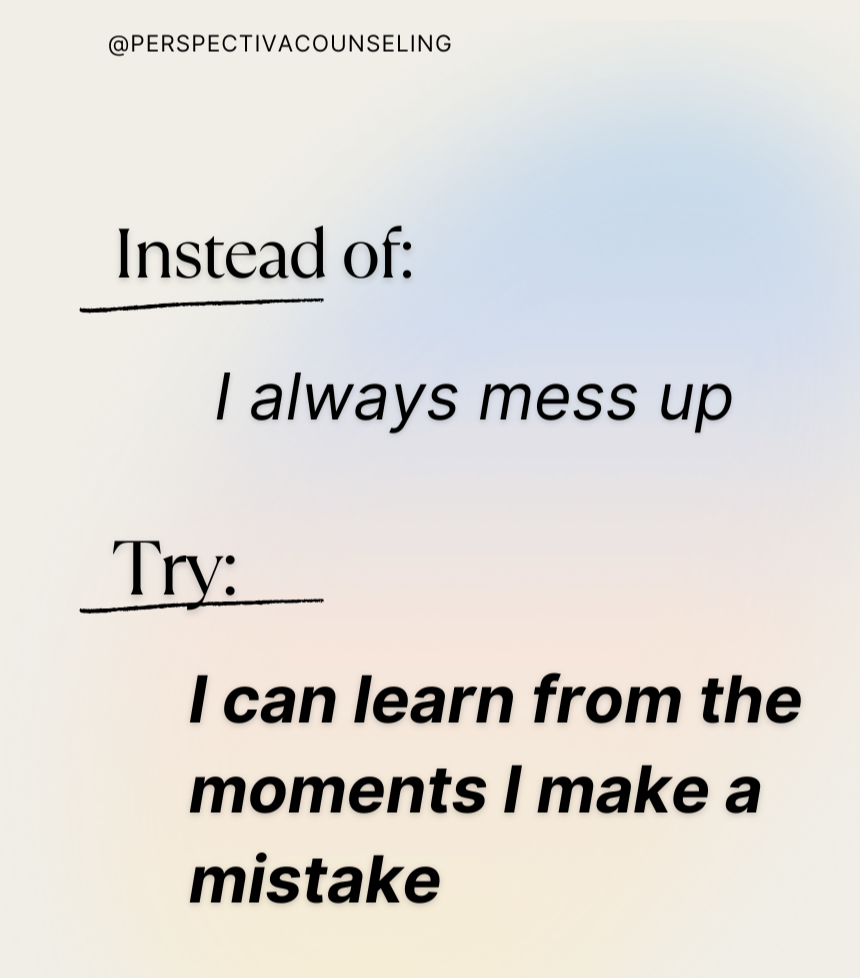
I have to tell you something that may be a hard pill to swallow. The internal voice in your brain, you know the one that is constantly narrating your life, may not be on your side. As a matter of fact, it may be making you feel worse depending on what it is telling you. Oftentimes, we talk to ourselves in a way that we would never dream of speaking to others. I’m guilty of this too. Many times, clients will share that their inner thoughts tell them that they “always mess up” or they “never get it right.” Cognitive distortions are any thought that is irrational, biased, skewed in reality, and lead to unhelpful emotions and behaviors. These cognitive distortions are rarely true, yet by repeating it to yourself, your brain believes that it is true.
The more that we use cognitive distortions, the easier they come to our brain, which can lead to feelings of depression, anxiety, and overwhelm. It creates a cycle that can feel hard to break. The emotions can then lead to actions which starts the entire process over again. Here’s an example.
I’m sure most of you know that the job market is rough out there right now. I’ve had friends apply for multiple jobs just to not hear back. Now let’s say after applying for the 10th job that day, you receive a rejection letter. The thought that comes into your mind is “I’m never going to get hired. I always get rejected.” Immediately this makes you feel hopeless. Depressed. Down in the dumps. You may decide that since you “never” will be hired and you “always” get rejected, it’s not worth applying anymore. You decide to call it quits. Your negative thought affected your feelings, which then led to a certain behavior.
In this example, the absolute words always and never gave no nuance to the situation. It made it seem final, even if that wasn’t the case. As a matter of fact, when we use absolutes, they rarely ring true. Think about it. When is the last time that something actually never, ever happened? When is the last time that you could garuntee something, 100%? Chances are, these moments are slim, but when we use language like this, it can perpetuate depressive and anxious thoughts, which lead to actions that continue the cycles of depression and anxiety.
The good news is that there is a way to work on this! The first step is recognizing when the distortions come. This can actually be tricky, because the mind loves to play tricks on you. If you’ve been talking to yourself this way for years, you may not even notice it. Therapy is a great tool to help you identify these cognitive distortions, and work on reframing them. Once you are able to identify the distortion, the next step is changing how you speak to yourself.
Instead of using words like always and never, switch to sometimes, often, a lot, and frequently. Let’s take the previous example. You are applying for jobs, and get that rejection. You at first think, “ I always get rejected,” but then you remember that you’ve been receiving the rejections right now, and this rejection does not predict the future. You think about the times you have been accepted with your current employment and times in the past. Even though the distortion came, you recognized it, and thought about it in a different way. Instead of feeling hopeless and giving up, you continue to work on it.
When it comes to your thoughts, try to tell yourself words that lead to growth rather than shame and guilt. I’m not asking you to lie to yourself, but reframe your thoughts to treat yourself with kindness.